
The Life Photo Archive Sees the Light of Day via Crowley Digitization Services
Client
Time Inc.
Project:
Digitization of The LIFE Photo Archive for Google hosting
Statistics:
10.5 million images (primarily negatives) dating from 1936 to 2000
Solution:
- 300 dpi color/grayscale scanning
- Metadata collection
- High-volume daily deliveries
- Ultra Density Optical (UDO) and hard drives; Blu-Ray drives
- Dedicated staff resources
Everything Old Is New Again
Imagine seeing 75 years of history scroll across your screen every day. For two years. And you couldn’t talk about it. Such was life (pun intended) for approximately 20 of The Crowley Company‘s employees tasked with digitizing over 10 million images from Time Inc.’s LIFE magazine archives. For nearly three years, dedicated Crowley staff witnessed never-publicized photos of distinguished personalities and celebrities, world events, wars, scientific advances and the intimate drama of daily life. From rural towns to big cities to a dog with two heads, they saw – and scanned – it all. Today the secret is out and the entire world can participate at https://artsandculture.google.com/partner/life-photo-collection
The Collection
Known as LIFE’s Photo Archive, the project is a digitization of the historic photographic images taken for LIFE magazine, which printed from 1936 to 1972 and again from 1978 to 2000. The collection includes color and black and white negatives, transparencies, reflective prints and other photographic material. As of this study’s first print, the LIFE Photo Archive on Google was among the largest professional photography collections on the web and one of the largest scanning projects ever undertaken. The archives contain photographs from over 50 world-renowned photojournalists including Margaret Bourke-White, Ed Clark, Alfred Eisenstaedt, Nina Leen, Gordon Parks and others. The collection is available online free for personal and research purposes. Copyright and ownership of all images remain with Time Inc. and high-quality photographic prints can be purchased at the site.
The Digitizing Process
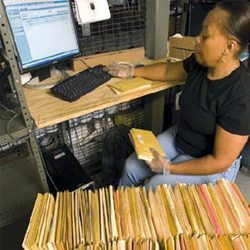
Approximately every three months, representatives from Crowley drove climate-controlled trucks to warehouses in northern New Jersey and New York to collect file cabinets that stored the images (primarily negatives) in bar-coded envelopes. The entire file cabinet was loaded onto the truck and delivered to Crowley’s 18,000 SF service bureau in Frederick, Maryland, in the Washington/Baltimore corridor. There, each envelope was scanned to ensure that the contents matched the manifest of Time Inc. Next, the negatives were scanned, emulsion side down, at the rate of nearly one every 30 seconds or approximately 14,000 a day. From there, the quality control staff checked each image on computer screens for quality and alignment, attached a Digimarc (an electronic watermark) and typed in appropriate cataloging indexing information such as subject and photographer.
The final step was the return of the physical and digital images to the clients. Physically, the file cabinets were driven back to the warehouse(s), where the next set was picked up. Digitally, images were sent via ultra density optical drives (UDO), Blu-ray discs or hard drive, as required by the client.
When asked about the challenges of such a high-volume project, Crowley Digitization Services project manager noted, “It eventually came down to a science, although the early months offered a lot of learning opportunities. Every time we’d open a negative drawer, there was a ‘size surprise’ and we became quickly adept at having stations for every type of image—35mm, 120 mm, 4×5’s, 8×10’s, prints, you name it.” She continued, “It was impossible not to be awed by this collection. In the beginning there was a lot of ‘Hey, check this out,’ but we quickly realized that almost every photo in the collection had a ‘wow’ factor.”
The Results
Andy Blau, LIFE’s president at the time of this project, stated that, “Crowley was selected for the digitizing task because of their advanced photo-digitizing solutions, long corporate history of providing quality workmanship in a high-volume scanning environment and their staff’s expertise with the handling of digital imagery and numerous types of analog photographic media.” With more than two million images online for viewing in just the first month, the project was deemed a success. “Working on this project has been a privilege,” notes Patrick Crowley, president of the Crowley Company. “Not only was it one of the most socially interesting archives we’ve digitized, it propelled us to develop some creative production approaches, such as the designing and engineering of a custom camera stand that allowed for increased scanning volume and quality of 35mm negatives. We also invested in a workflow application that allowed us to manage a project of this size in a way that was cost-efficient for both ourselves and the client.”
“Crowley was selected… because of their advanced photo-digitizing solutions, long corporate history of…quality workmanship in a high-volume scanning environment…and their staff’s expertise.”~ Andy Blau, LIFE president